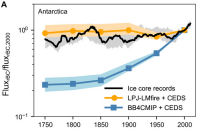
A new paper (Liu et al 2021) published in Science Advances presents evidence from records of 14 Antarctic ice cores and 1 central Andean ice core, suggesting that historical fire activity in the Southern Hemisphere (SH) exceeded present-day levels. SH aerosols from fires have declined by about 30% over the 20th century. This is likely due to the expansion of land use for agriculture and animal production. The decline of fire soot aerosols negates the cooling effect of increasing aerosols from fossil fuels and biofuel sources. The fire activity over human-managed land is lower than that under natural conditions. The global burned area observed by satellite decreased 24% over the past two decades.
The paper's abstract says:
Fire plays a pivotal role in shaping terrestrial ecosystems and the chemical composition of the atmosphere and thus influences Earth’s climate. The trend and magnitude of fire activity over the past few centuries are controversial, which hinders understanding of preindustrial to present-day aerosol radiative forcing. Here, we present evidence from records of 14 Antarctic ice cores and 1 central Andean ice core, suggesting that historical fire activity in the Southern Hemisphere (SH) exceeded present-day levels. To understand this observation, we use a global fire model to show that overall SH fire emissions could have declined by 30% over the 20th century, possibly because of the rapid expansion of land use for agriculture and animal production in middle to high latitudes. Radiative forcing calculations suggest that the decreasing trend in SH fire emissions over the past century largely compensates for the cooling effect of increasing aerosols from fossil fuel and biofuel sources.
The implications of the study are discussed in this article by Pierre Gosselin. Global climate models show that global average temperatures should have risen of 1.5°C since 1850 due to the higher greenhouse gas concentrations but it has instead risen by only 1.1°C. The modelers falsely claim that higher the 20th and 21st centuries aerosol levels in the atmosphere compared to 1850 has a cooling effect of 0.4°C. The Liu et al 2021 paper shows that atmospheric aerosols in the preindustrial times were just as high as they were just recently. It means CO2 climate sensitivity has been overestimated. “The consequences for the climate models could be enormous,” Die kalte Sonne adds. “This means that CO2’s warming effect thus has to be much less.”
Trends of Black Carbon Deposition Fluxes at Antarctica
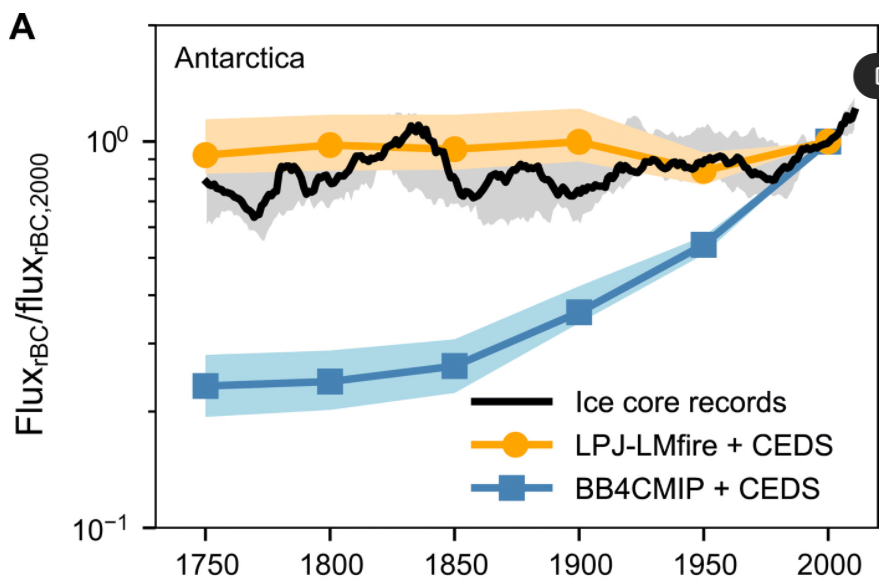
The figure above is Figure 2A from Liu et al 2021. The figure shows the measured and modeled trends of black carbon deposition fluxes at Antarctica. The trends are shown as the ratios of historical black carbon fluxes to present day values (centered around the year 2000). Thick curves represent the median values of 12 ice core records or colocated modeled results. Shaded areas represent the 25th to 75th percentile range across sites. The black curve is the measured black carbon deposition fluxed from ice cores. The blue curve is the modeled fluxes from a climate model used in the CMIP6 for the IPCC. The yellow curve is the modeled fluxed using a satellite-constrained fire emissions database with a state-of-the-art fossil fuel and biofuel emission inventory. The authors' model agrees well with the ice core records.